
Tesla’s New Roadster Doesn’t Drive. It Launches, Flips, and Lands
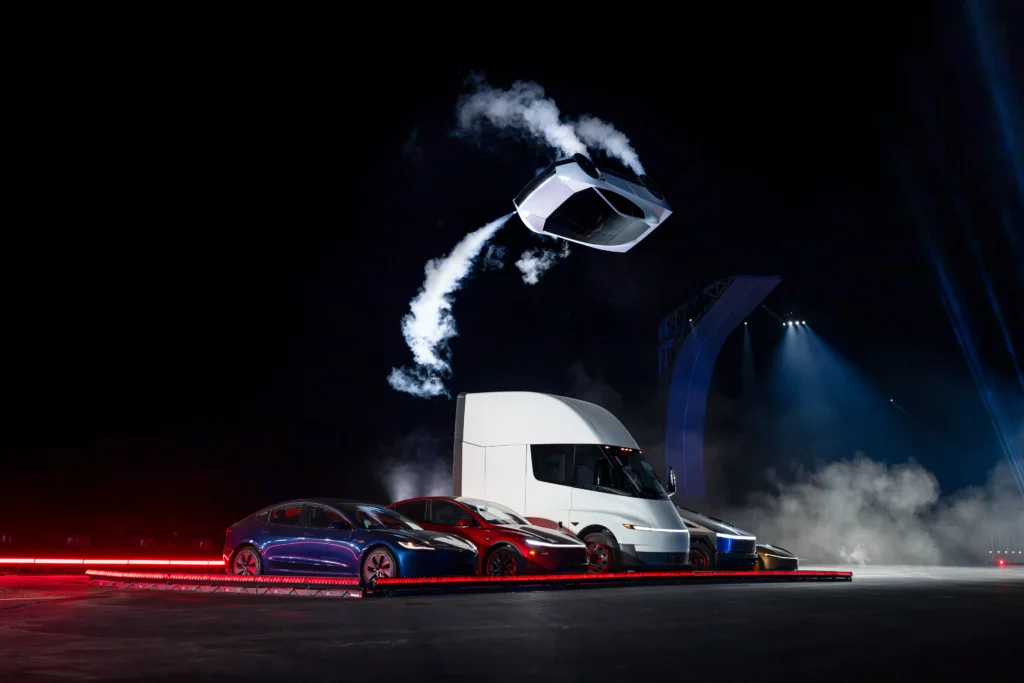
For years, people joked that we’d get flying cars before certain sequels or long-promised books. On October 15, 2026, Elon Musk basically said, “Hold my compressed air,” and showed a Tesla Roadster doing things that looked like they belonged in a cartoon.
At a SpaceX test facility in Texas, Musk and the Tesla team revealed the long-delayed next-generation Roadster. This isn’t a normal sports car with a few extra lights. It uses cold-gas thrusters — basically high-pressure air jets borrowed from rocket tech — along with a suction system underneath. During the demo, the car drove up a curved ramp, stuck itself upside down using the suction, launched off, flipped in the air, and landed. Later it hopped over a line of other Teslas using the thrusters. Musk called it flying like a rocket and posted on X: “Turns out the future does have flying cars.”
Let’s be clear about what “flying” means here. This isn’t an airplane or an eVTOL that lifts off and cruises across town. It’s short hops, flips, and controlled landings using compressed air thrusters. Experts watching it described it more as hopping than sustained flight. The demo car was controlled remotely so no one got hurt, and Musk himself noted that success wasn’t guaranteed and that he wasn’t sure the flying version would be legal everywhere. He also admitted it isn’t optimized for safety — it just “takes the fun meter to 11.”
On the ground, the performance claims are wild. Tesla showed (and claimed) 0-60 mph in under a second, with some numbers around 0.81 seconds. Top speed is listed above 230 mph, and Musk talked about eventually going much faster. There are three versions planned: a Performance model with the suction system for better grip, a Thrust version that adds rear thrusters for the crazy acceleration, and an invite-only Rocket version that has the full flight system (and only one seat). Production is promised for 2028. If you’ve followed Tesla timelines, you already know to treat that date as optimistic. The original next-gen Roadster was shown back in 2017 with a 2020 target.
How does the thruster part work? High-pressure air tanks feed about ten nozzles around the car. The tanks hold a large amount of compressed gas, and the system can create serious thrust for short bursts. Refilling those tanks currently takes hours, though Tesla says it’s working on making that much faster. The same hardware that helps it hop also aids extreme acceleration and cornering by pushing the car down.
Is it practical for everyday use? Not really, at least not yet. The flying version isn’t approved for public roads, regulators will have a lot to say about anything that leaves the ground, and you won’t be commuting over traffic in it anytime soon. What it does show is what happens when a car company and a rocket company share ideas and hardware. Whether it becomes a real product people can buy and enjoy, or stays mostly a spectacular demo, depends on engineering, safety, regulations, and Tesla actually hitting that 2028 date.
For now, it’s the closest thing we’ve seen to the old “flying car” dream from movies and cartoons — just with a lot more compressed air, a remote control, and Elon Musk telling everyone it’s real. The future arrived, sort of. It hops. And it looks like a lot of fun if you ignore the paperwork.
Watch Full Video Here
https://www.youtube.com/live/qt5p-_tE8d0?si=yRTRgcB0RtsVfCdC