
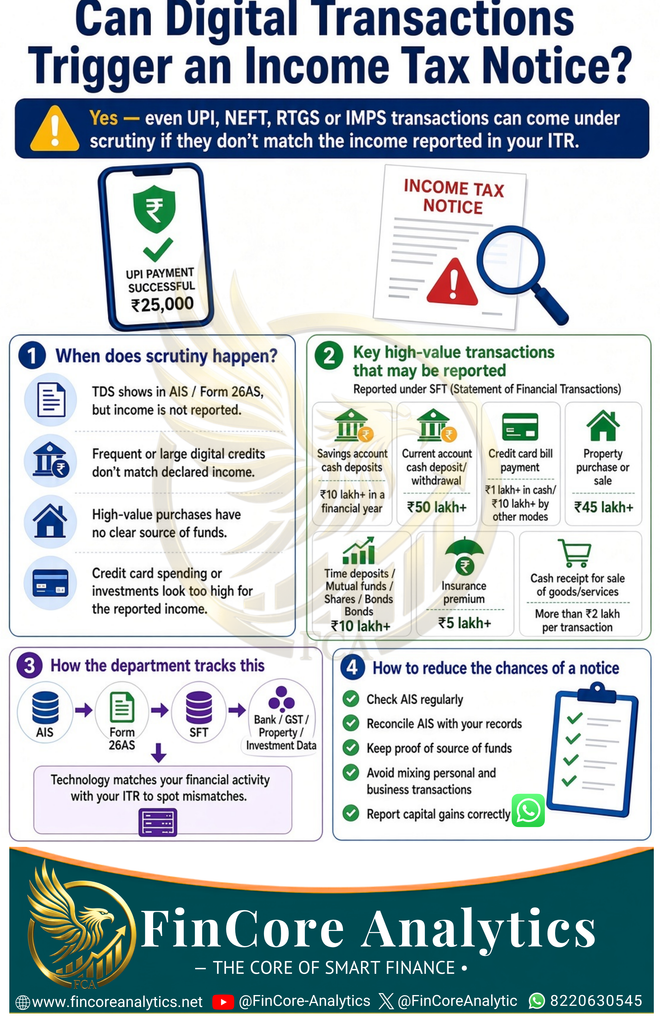
A UPI payment, NEFT, RTGS or IMPS transfer is not a problem by itself. The tax department does not send a notice just because you paid your electricity bill or sent money to your parents. What it looks at is whether the money moving through your accounts matches the income you declared in your ITR.
Banks, registrars, credit-card companies and mutual fund houses already report high-value activity to the department through the Statement of Financial Transactions. That data lands in your Annual Information Statement, which you can see on the income-tax portal. The system then compares AIS with your return. If the two do not talk to each other, a notice can follow.
Take a common example. A salaried person in Pune shows ₹8 lakh salary in the ITR, but the savings account receives ₹18 lakh during the year through UPI and IMPS from different people. Even if each transfer looks small, the total does not match the declared income. That is the kind of gap the system flags.
Another example: a family buys a flat in Hyderabad for ₹55 lakh and pays through RTGS. The registrar reports the deal. If the ITR shows modest income and there is no gift deed, loan paper or sale of an old asset to explain the source, the department may ask where the money came from.
The same logic applies to credit cards. If annual spends cross about ₹10 lakh, or cash paid towards the bill crosses ₹1 lakh, the issuer reports it. A person showing ₹6 lakh income and running up ₹12 lakh on cards will look inconsistent.
Other transactions that often get reported include cash deposits of ₹10 lakh or more in a savings account in a year, cash deposits or withdrawals of ₹50 lakh or more in a current account, investments of ₹10 lakh or more in deposits, mutual funds, shares or bonds, insurance premium of ₹5 lakh or more, and property deals around the ₹45 lakh mark.
The practical habit is simple. Open AIS before you file. If a credit is a gift from a parent, keep the bank trail and a short gift confirmation. If it is a loan from a friend, keep the agreement. If it is business money, show it in the return. Do not mix personal and business accounts if you can avoid it. Digital payments are visible. Matching them with your ITR is what keeps a notice away.